Introduction
On 14 October 2016, the House of Representatives passed amendments to the Income Tax Law in order to align the current Cyprus IP tax legislation with the provisions of Action 5 of the OECD’s Base Erosion and Profit Shifting (BEPS) project. The amendments apply retroactively, as from 1 July 2016. The revised legislation includes certain transitional provisions for IP assets that have already qualified under the existing IP box regime. In such cases, taxpayers will continue to benefit from the existing IP regime for a maximum of five years, after which date the new IP tax regime shall apply.
Cyprus IP box regime tax benefit: In essence, both the transitional and the new Cyprus IP box regime offer a tax benefit of up to 80% on qualifying IP profit, by way of notional expense deduction.
Transitional arrangements
Benefit under the current IP regime until 30 June 2021 With a view to protect the owners of IP assets that have already qualified under the current Cyprus IP regime, transitional provisions have been introduced in the legislation. According to these, taxpayers benefiting from the current IP regime shall continue to apply its provisions until 30 June 2021, as long as the intangible assets in question have either generated income, or their development was completed as at 30 June 2016 and the intangible assets were acquired: prior to 2 January 2016; or
either directly or indirectly from a related person during the period from 2 January 2016 to 30 June 2016, and which assets at the time of their acquisition were benefitting under the Cyprus IP box regime or under a similar scheme in any other country; or
from a non-related person, or were developed by the taxpayer himself during the period from 2 January 2016 to 30 June 2016.
Benefit under the current existing IP regime until 31 December 2016 For intangible assets acquired directly or indirectly from a related person during the period from 2 January 2016 to 30 June 2016 and which do not fall under the provisions of (b) above, the transitional period extends only up to 31 December 2016. Embedded Income and Economic Ownership The income from IP’s that qualify for the transitional provisions will now include embedded income arising from the commercial use of such assets, or income from such IP assets for which only economic ownership exists. Tax treatment under transitional arrangements 80% notional tax deduction on qualifying IP profit, including gain from a qualifying IP disposal.
Provisions of the NEW Cyprus IP box regime
The new IP regime complies with the provisions of the modified ‘nexus approach’, whereby for an intangible asset to qualify for the benefits of the regime, there needs to be a direct link between the qualifying income and the own qualifying expenses contributing to that income. In brief, an amount equal to 80% of the qualifying profits earned from qualifying intangible assets will be allowed as a tax deductible expense. Qualifying intangible assets patents, as defined in the Patents Law computer software other IP assets which are legally protected and fall within one of the following categories: utility models, intellectual property assets which provide protection to plants and genetic material, orphan drug designations and extensions of protections for patents non-obvious, useful and novel, where the person utilizing them in furtherance of a business does not generate annual gross revenues in excess of €7,500,000 from all intangible assets (€50,000,000 in case of a group of companies), which are certified as such by an appropriate authority, in Cyprus or abroad
As per the amended legislation, “qualifying intangible asset” is defined as an asset which was acquired, developed or exploited by a person within the course of carrying out his business (with the exception of intellectual property related to marketing), which is the result of research and development (R&D) activities, and which includes intangible assets for which only economic ownership exists. Qualifying intangible assets comprise of: The definition of qualifying intangible assets specifically excludes business names, brands, trademarks, image rights and other intellectual property rights used for the marketing of products and services. Qualifying profit
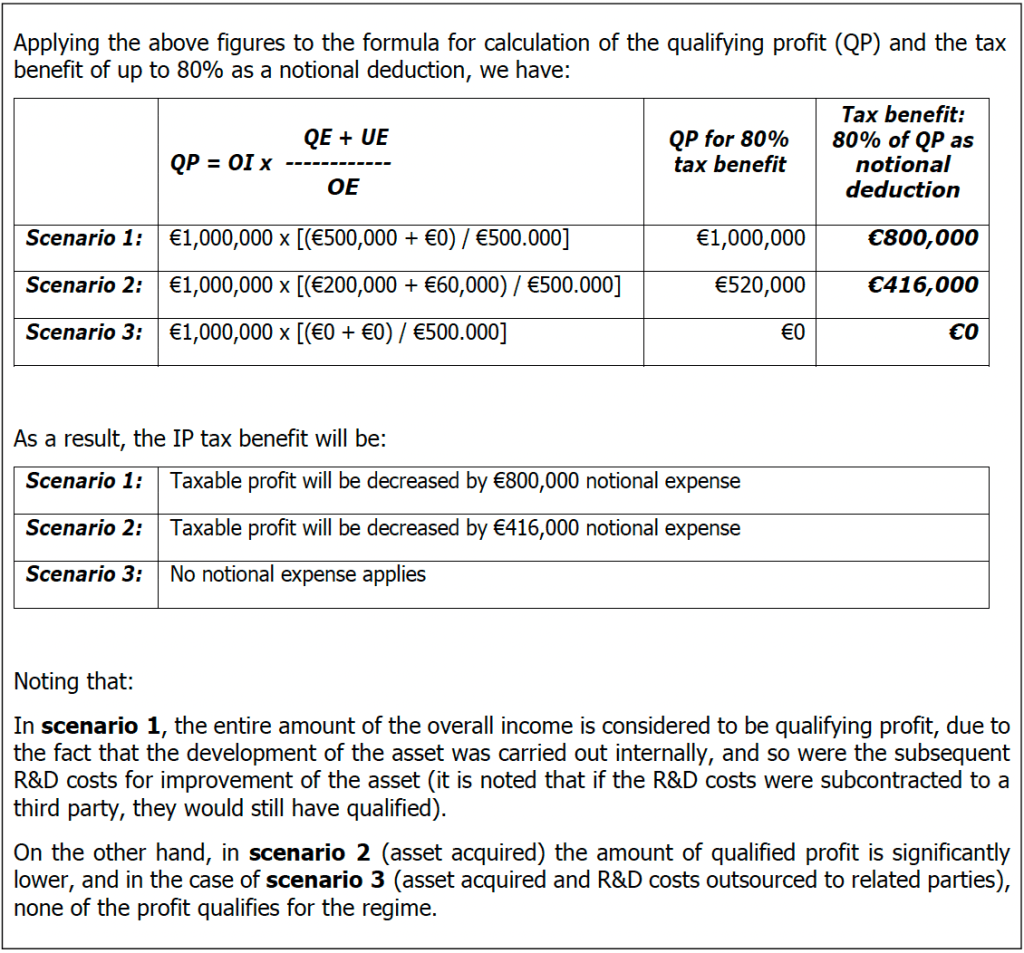
Qualifying profit (QP) is defined as the proportion of the overall income (OI) derived from the qualifying asset, corresponding to the fraction of the qualifying expenditure (QE) plus the uplift expenditure (UE) over the overall expenditure (OE) incurred for the qualifying intangible asset. The amount of qualifying profit can be derived through the application of the following formula: QP = OI x (QE + UE) / OE. The relevant terms are explained in the next section.
Tax benefit:
For the purpose of calculating the taxable profit, 80% of the qualifying profit derived from qualifying intangible assets is treated as a deductible expense. For each tax year, the taxpayer may elect to waive this allowance, either in part or in whole.
By the same token, in case where a loss is incurred, only 20% of this loss can be surrendered to other group companies or be carried forward to subsequent years.
- RELEVANT TERMS EXPLAINED
- Overall Income (OI) royalties or other amounts resulting from the use of qualifying intangible assets
- license income for the operation of qualifying intangible assets
- any amount received from insurance or as compensation in relation to qualifying intangible assets
- income from the disposal of qualifying intangible assets, excluding profits of a capital nature
- embedded income of qualifying intangible assets arising from the sale of products or services, or from the use of procedures that are directly related to the assets
- all costs incurred, either directly or indirectly, wholly and exclusively for the purpose of earning the income from qualifying intangible assets
- the amortization of the cost of the assets
- notional interest on equity contributed to finance the development of the assets (being a notional interest tax deduction allowed by Cyprus tax provisions)
- wages and salaries
- direct costs
- general expenses relating to installations used for R&D
- commission expenses associated with R&D activities
- costs associated with R&D that has been outsourced to non-related persons
Overall income is defined as the gross income earned from qualifying intangible assets during the tax year, minus any direct costs incurred for generating the income.
Overall income includes, but is not limited to:
For the purpose of calculating overall income, direct costs include:
(b) Qualifying Expenditure (QE)
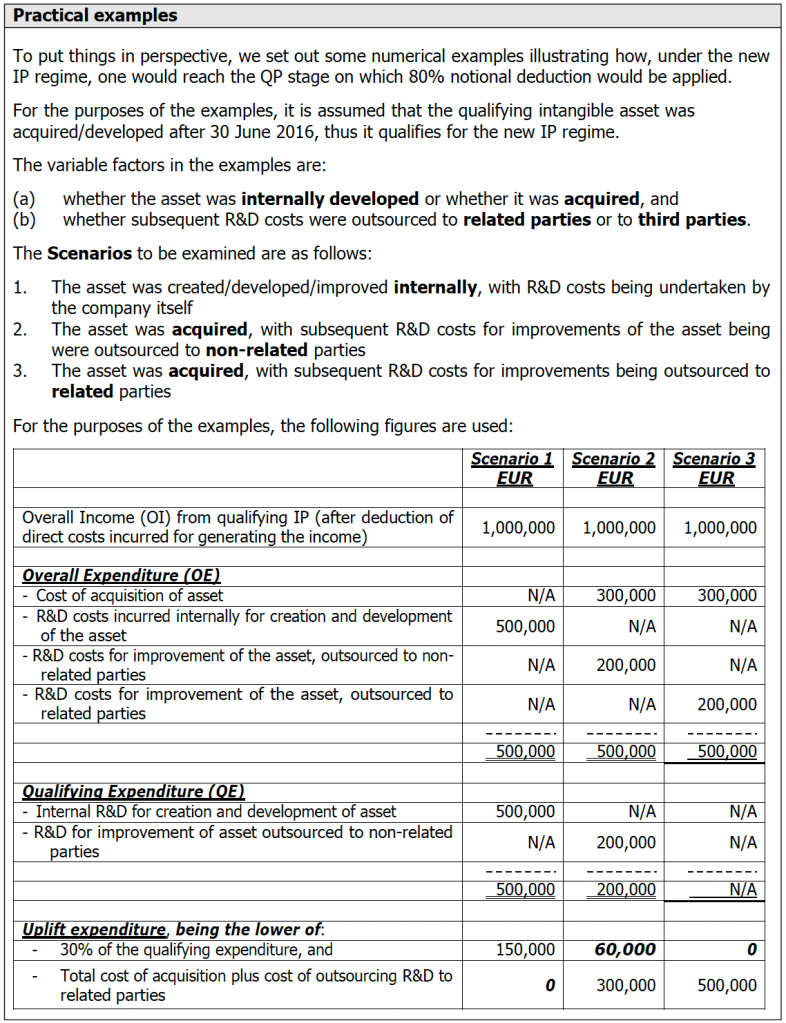
Qualifying expenditure for qualifying intangible assets is defined as the sum of all R&D costs incurred during any given tax year wholly and exclusively for the development, improvement or creation of qualifying intangible assets, and which costs are directly related to such assets.
Qualifying expenditure includes, but is not limited to:
- wages and salaries
- direct costs
- general expenses relating to installations used for R&D
- commission expenses associated with R&D activities
- costs associated with R&D that has been outsourced to non-related persons
However, qualifying expenditure does not include:
- costs for acquisition of intangible assets
- interest paid or payable
- costs for acquisition or construction of immovable property
- amounts paid or payable directly or indirectly to a related person to conduct R&D activities, regardless of whether such amounts relate to cost sharing agreements
- costs which cannot be proved directly connected to a specific qualifying intangible asset
However, qualifying expenditure does not include:
Any expenditure for R&D that has been outsourced to non-related parties, as well as any expenses of a general nature for R&D which cannot be allocated to the qualifying expenditure of a specific qualifying intangible asset, can be apportioned pro rata to the qualifying intangible assets.
(c) Uplift Expenditure (UE)
An uplift expenditure is added to the qualifying expenditure, which will be equal to the lower of:
- 30% of the qualifying expenditure; and
- the total cost of acquisition of the qualifying intangible assets, plus the cost of outsourcing to related parties of any R&D activities in relation to such assets.
(d) Overall Expenditure (OE)
Overall expenditure relating to qualified intangible assets is defined as the sum of:
- the qualifying expenditure; and
- the total cost of acquisition of the qualifying assets, plus the cost of outsourcing to related parties of any R&D activities in relation to these assets, incurred during any tax year.
D. Accounting records
Persons claiming benefits under the new regime are obliged to maintain proper books of account, as well as records of income and expenses for each intangible asset.
E. Non-qualifying assets for the IP Box regime
Expenditure for the acquisition of an intangible asset that does not qualify for the transitional provisions, and which asset is used in furtherance of the business, can be amortized over the asset’s useful life, in accordance with accepted accounting principles, with a maximum period of 20 years.
In case where the asset is disposed, a balancing statement needs to be prepared, similarly to cases of disposals of fixed assets. It is noted that goodwill does not qualify for amortization.